
WHAT ACTUALLY HAPPENS WHEN YOU HOLD YOUR BREATH?
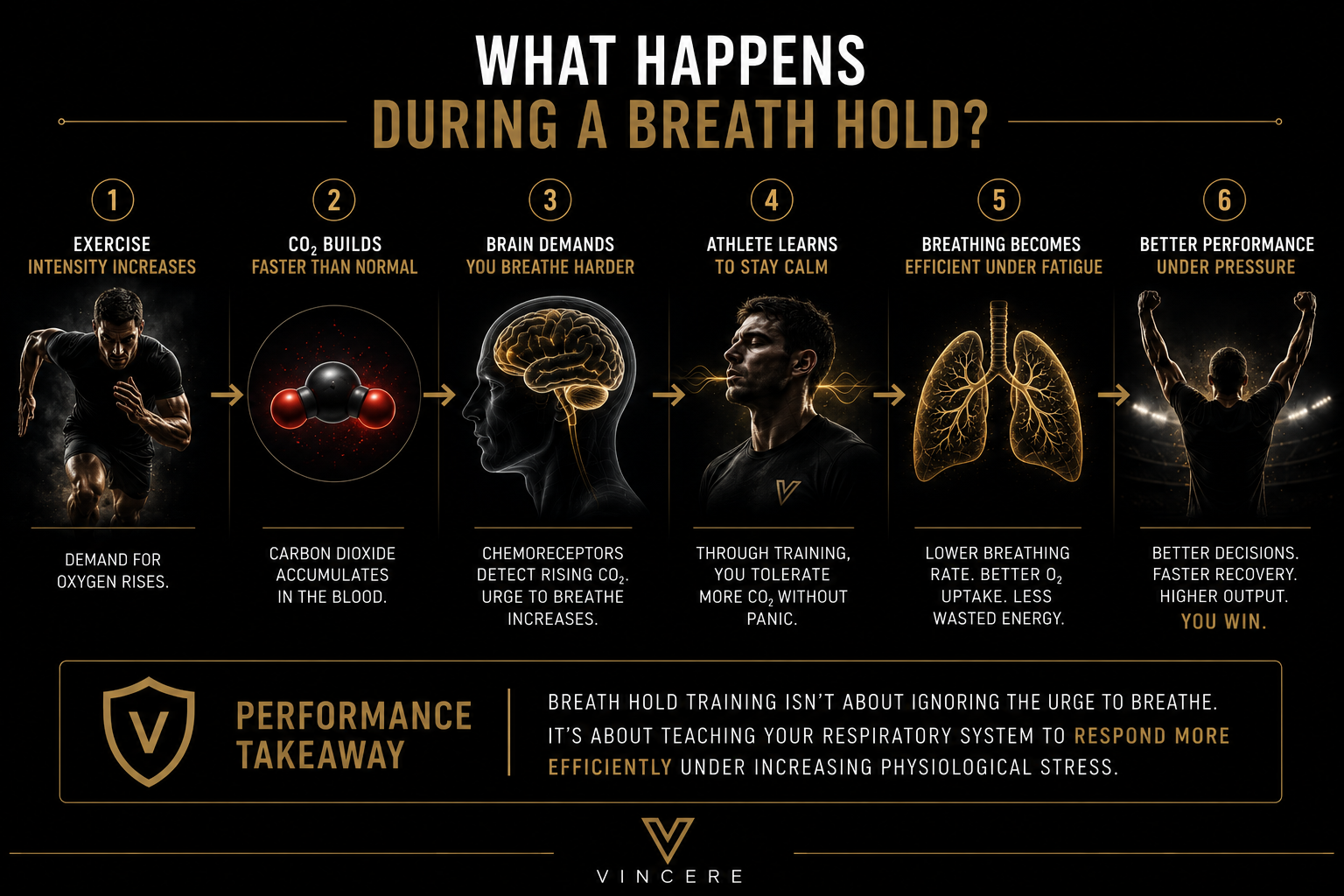
THE FIRST THING THAT FAILS UNDER FATIGUE ISN'T YOUR MUSCLES. IT'S YOUR CONTROL.
Every elite athlete has experienced it.
The race changes.
The game changes.
The fight changes.
Your legs begin to burn.
Your heart is pounding.
Every breath feels harder than the one before.
Your body is screaming for air.
This is the moment that separates champions.
Not because they're stronger.
Because they continue making quality decisions while everyone else begins to lose control.
Most athletes believe they're struggling because they're running out of oxygen.
They're not.
The first battle is against carbon dioxide (CO₂).
YOUR BODY IS DESIGNED TO RESPOND TO CARBON DIOXIDE
Every breath has two essential jobs.
Deliver oxygen to your working muscles.
Remove carbon dioxide produced as your muscles generate energy.
Most athletes assume oxygen is the main reason we breathe.
In reality, carbon dioxide is the primary driver of breathing.
Every second you compete, your muscles produce more CO₂.
As it accumulates in your bloodstream, specialised chemoreceptors in your brainstem and major arteries constantly monitor its concentration.
When CO₂ reaches a certain level, your brain responds by increasing your drive to breathe.
That tightening in your chest.
The urge to gasp.
The overwhelming feeling that you need air.
These sensations are usually driven far more by rising carbon dioxide than by dangerously low oxygen.
This is one of the body's normal protective mechanisms.
WHY BREATH HOLD TRAINING WORKS
Breath hold training isn't about becoming better at holding your breath.
It's about exposing your respiratory system to controlled physiological stress.
Instead of automatically responding to rising carbon dioxide with faster, heavier breathing, your respiratory system learns to remain more efficient and composed.
Over time, this training may help improve carbon dioxide tolerance, reduce unnecessary ventilation during exercise and support more efficient breathing under fatigue.
For elite athletes, that can mean remaining calmer, making clearer decisions and maintaining technical execution deeper into competition.
The objective has never been a longer breath hold.
The objective is a respiratory system that continues performing when the pressure is highest.
WHY THIS MATTERS IN ELITE SPORT
Championships rarely come down to who was best in the opening minutes.
They are decided by who can still execute when fatigue begins to dominate.
The midfielder still covering the ground in the final quarter.
The fighter remaining composed in Round 5.
The rower holding technique over the last 500 metres.
The basketball player calmly making free throws with a heart rate above 180 beats per minute.
The cyclist producing one final attack when everyone else has already emptied the tank.
These moments are not simply tests of fitness.
They are tests of physiological control.
Performance takeawayElite athletes don't train breath holds to hold their breath longer.
They train their respiratory system to stay efficient when carbon dioxide rises.
To stay composed when fatigue builds.
To keep executing when others begin to break down.
Because at the highest level of sport, the athlete who controls their breathing under pressure gives themselves the best opportunity to control the outcome.